Nobody hands you a manual for this. You unbox a griddle, the card inside says pre-seasoned and ready to cook, and then the first pancake tears in half and you blame the pan. It wasn't the pan. Learning how to season a new griddle is a 30-minute job, and most of that time is spent waiting for metal to cool down while you stand in the yard with a cup of coffee.
I cook on flat tops for a living. Thirteen years on the line, eight of them on a diner griddle that ran 400 breakfasts a morning, and these days a food trailer plus a backyard griddle in Phoenix that gets fired three times a week minimum. The two surfaces in this guide cover the two ways almost everybody starts: a cast iron plate that works on a stove, a grill, or a campfire, and an electric griddle that lives on the counter. Different surfaces, different first day, same habit underneath.
Why you should trust me
I'm not a guy who bought a griddle last summer and made a video about it. I spent 13 years on the line, eight of those working a four-foot commercial flat top where the breakfast rush was 400 covers before 10 a.m. I keep a scraper and a squeeze bottle in my truck the way other people keep a phone charger.
What that means for you is a short list of things I actually care about. Does the surface heat evenly? Does the grease go somewhere useful instead of pooling at the front edge? Is the seasoning still there in 60 days, or did it flake off in week two? I don't make claims about a griddle that never rusts, because everything rusts if you neglect it, and I say so. And I don't quote a temperature I haven't seen on a surface thermometer.
What I check before I season anything
Four things, in this order.
The surface material. Bare steel, cast iron, or a ceramic nonstick coating. Each one gets a different first day, and treating a ceramic griddle like cast iron is how people ruin a ceramic griddle.
Whether the cooking surface is flat. Lay a straightedge across it in a couple of directions. If you can see light under the middle, the plate is warped and no amount of seasoning will fix uneven heat. A warped griddle is a lifetime of uneven burgers, so send it back before you oil it.
The grease management. Find the drip tray, pull it out, and put it back. If a tray is hard to remove when it's clean, imagine it full of bacon fat on a Sunday morning. A bad grease trap ruins every cook, and it's the first thing I look at on any griddle.
The size. You don't need 36 inches. You need enough surface for what you actually cook on a Tuesday night. A big griddle that only comes out twice a year is a storage problem with handles.
The two griddles below are the two starting points I hand to people who ask. One is cast iron you can carry outside, one is electric and stays indoors, and both take a first day of work before they earn their keep.
The two surfaces worth starting on
Here's the honest split. Cast iron is the cheap, tough, portable option that asks for maintenance. The electric griddle is the convenience option that asks for clean tools and an outlet. Pick the one that matches where you cook, not which one sounds more serious.
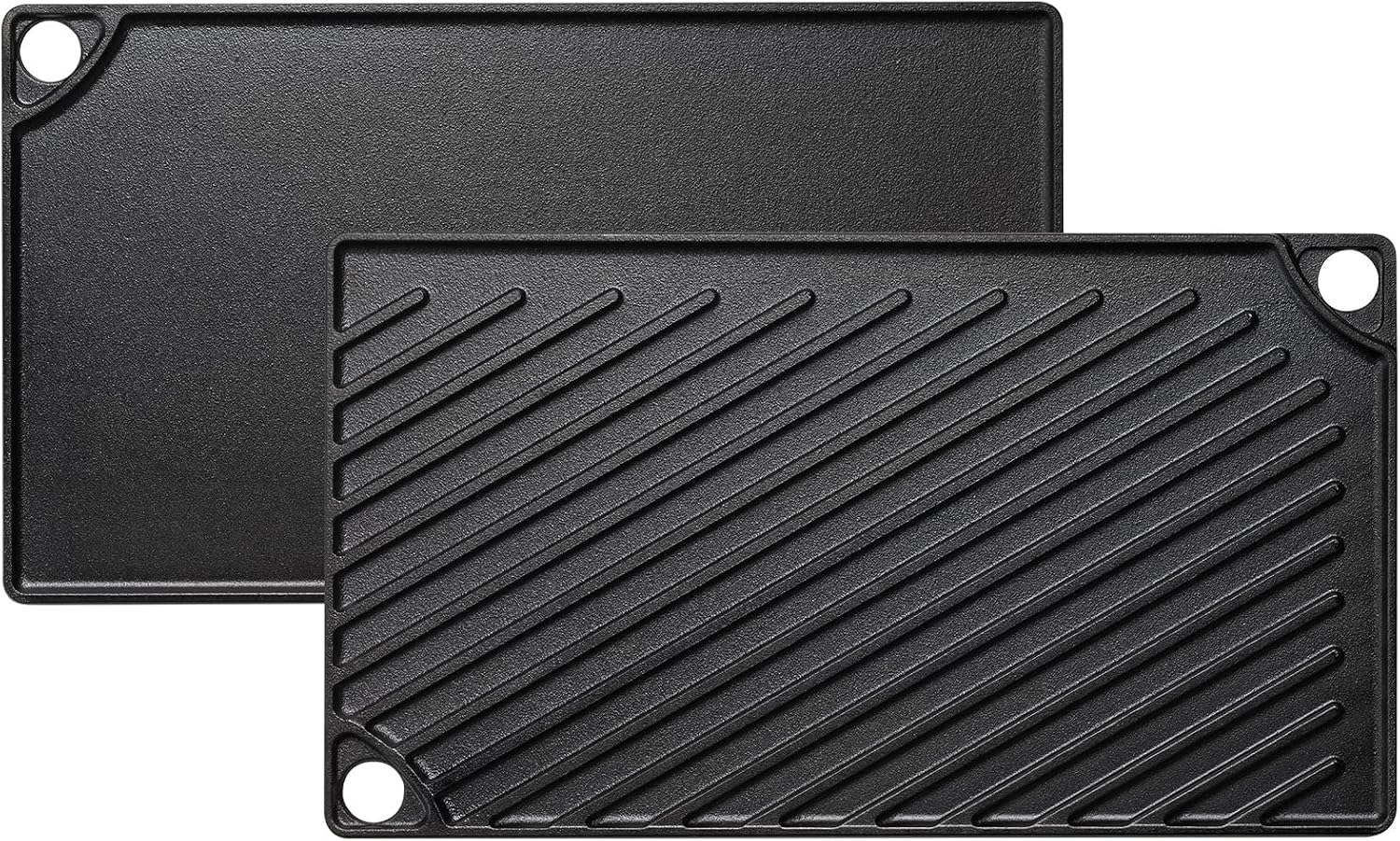
Budget pick: EWFEN Reversible Grill/Griddle, 16.7x9.5'' Pre-Seasoned Cast Iron Griddle Pan, Double Burner Cookware, Rectangular Stovetop Griddle with Handles, Flat Top Plate for Oven, Grill & Campfire
 Visit on Amazon →
This is the griddle I'd hand a beginner first, because cast iron teaches you the two habits that matter: heat control and immediate cleanup. It's pre-seasoned, so you're not starting from raw iron, but pre-seasoned means started, not finished. The flat side is a rectangular cooking surface at 16.7 by 9.5 inches, sized to sit across two stovetop burners, and the handles make it easy to move with a towel or a glove. Flip it and you get a ridged grill side.
What makes it the budget pick is what it doesn't need. No cord, no outlet, no electronics to fail. It goes on a gas stove, a charcoal grill, in an oven, or over a campfire, which is why it's the one that travels. Cast iron also holds heat, so when you lay cold burger patties on it, the surface recovers instead of dropping into a simmer.
Flaws but not dealbreakers: It's heavy, and it stays hot for a long time after you kill the burner, so clear a landing spot before you pick it up. Both sides want oil. And if you never use the ridged side, it will quietly rust on you, because nobody re-oils a surface they forgot about.
Anyone with a gas stove, a grill, or a campfire ring who wants one pan that does breakfast and dinner will get their money out of this.
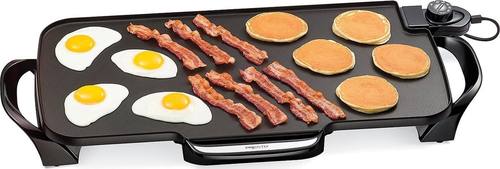
Upgrade pick: Presto 07061 22-Inch Electric Ceramic Griddle
 Visit on Amazon →
This is the countertop answer, and 22 inches of cooking surface is a real breakfast. Four pancakes, six eggs, and a pile of bacon can share the surface if you plan your zones. You plug it in, dial a temperature, and the heat is consistent without you standing over a burner adjusting a knob every two minutes. For an apartment, a patio with an outlet, or a kitchen where the stove is already crowded, that consistency is the whole argument.
The ceramic cooking surface is the part people get confused about. You do not season it the way you season iron. There's no raw metal to polymerize oil onto. What it wants is a wash, a dry, a thin film of oil wiped on and then wiped back off, and soft tools from then on. A metal spatula dragged across a ceramic surface is how a griddle that should last years ends up looking ten years old in one summer.
Flaws but not dealbreakers: It needs an outlet and a dry place to sit, so it's not the campfire griddle. The cord limits where you can set it up. And the ceramic surface is the one surface in this article that genuinely does not forgive a metal scraper, so buy a plastic or wooden scraper for it and keep the steel one for cast iron.
Anyone cooking indoors, on a covered patio, or in a rental kitchen who wants a big flat surface without tending a burner should start here.
How to season a new griddle: the step-by-step
This is the part people rush, and rushing it is why they end up with a sticky, gummy surface that grabs eggs. Slow down for one evening.
Step one: identify the surface. Cast iron and bare steel get seasoned with oil and heat. Ceramic nonstick does not. If you try to bake oil onto ceramic, you get a brown, tacky film that collects everything you cook. Read the material before you touch the oil.
Step two: wash off the factory film. Warm water, a rag, and a drop of dish soap. This is the only time soap is genuinely useful on a new griddle, because manufacturing leaves a residue that will bake into your first coat of seasoning. Dry it completely and immediately afterward, then set it on the heat for a couple of minutes to drive off anything left in the pores. Soap is not the enemy of seasoning. Standing water is.
Step three: heat it dry. Medium-low heat on a stovetop, or a moderate oven if the piece fits. You're not cooking anything. You're opening the surface and pushing out moisture so the oil has somewhere clean to bond.
Step four: oil it thin, then wipe it off. Put a dime-sized drop of a high smoke point oil on the surface and spread it with a folded paper towel or a rag. Then wipe it off like you spilled it and you're trying to hide the evidence. The rag should look almost dry when you're finished. Thin coats polymerize into a hard, slick layer. Thick coats turn into glue, and glue is what makes people think cast iron is overrated.
Step five: bring it to the smoke point. Let it come up until it just starts to smoke, hold it there for a few minutes, then cut the heat and walk away. Let it cool completely before the next round. You're not in a hurry, and the pan isn't either.
Step six: repeat. Three or four rounds for bare steel or raw iron. One or two for a pre-seasoned piece like the EWFEN, which already has a base coat. You're building layers, and layers take time.
Step seven: the egg test. Heat the surface to medium-low, add a little oil, crack an egg. If it slides when you nudge it, you're done. If it grabs and tears, season one more round and try again. That test tells you more than any instruction card.
Step eight: the electric griddle version. Wash the ceramic surface, dry it, wipe on a thin film of oil with a paper towel, wipe it back off, and cook. That's the entire ritual. Re-oil before each cook, and never season it like iron.
Your first cook: a full breakfast
Preheat longer than feels necessary. Five to ten minutes on a griddle is normal, and the difference between a griddle that's ready and one that isn't is a batch of pancakes where the first two are pale and the last two are dark. Flick a few drops of water on the surface. If they bead up and dance, you're there. If they just sit, wait.
Then work in order. Bacon and hash browns first, because they take the longest and the fat they leave behind is free seasoning. Eggs next, on lower heat than you think, and don't move them around. Pancakes last, or first if you've got kids circling the table. Pour, wait for the bubbles to pop and the edges to look dry, flip once, and leave them alone.
Keep the drip tray in place the entire time and empty it before it's full, not after. Fat that pools at the front edge is fat that's about to run onto your patio or your counter.
When you're done eating, clean while the surface is still warm. Scrape the flat top, push the debris into the trap, and wipe a thin film of oil across the surface before you walk away. That last wipe is the whole secret. Do it every time and you'll never think about rust again.
Where people get it wrong
The mistakes are consistent, and I've made most of them.
Too much oil. This is the number one seasoning failure. If the surface feels tacky when it cools, you used too much. Wipe it down, heat it again, and let it finish.
Cooking too hot. Cast iron and ceramic both punish high heat. You get a burnt outside and a raw middle, and on ceramic you also cook the coating toward an early death.
Soap panic. A light wash with soap won't destroy a seasoned surface. Leaving it wet in the sink overnight will.
Storing it damp, or with a lid on while it's warm. Trapped moisture is what rusts a griddle. In Phoenix I fight dust, but the monsoon weeks remind me that humidity does the same damage. Cool it, oil it, then cover it.
Never re-oiling after a cook. Seasoning is a habit, not a one-time event. A griddle that rusts was neglected, not defective.
Metal tools on a ceramic surface. Keep a plastic scraper for the electric griddle and the steel scraper for the cast iron, and don't mix them up.
Believing "pre-seasoned" means done. It means somebody started the job for you. You still finish it.
What this all costs
The cast iron is the smaller spend and the electric griddle is the bigger one, but neither is a serious purchase, and both are cheaper than replacing a griddle you ruined by skipping the first hour. The oil costs almost nothing, and a scraper plus a squeeze bottle costs less than lunch. Check current Amazon price on both before you decide, then think about cost per cook instead of sticker price. A griddle you use three times a week pays for itself in a month of skipped takeout.
The real cost is the evening you spend seasoning it, and that evening is the reason the next five years of breakfasts slide out of the pan instead of sticking to it.
Do it this weekend
Pick your surface, wash it, oil it thin, heat it until it smokes, let it cool, and repeat until an egg slides. Then cook a full breakfast on it and clean it while it's still warm. That's the entire job, and it's the same job whether you're standing at a campfire with a cast iron plate or at a counter with a 22-inch electric griddle. Hot surface, thin layer of oil, wipe it down, put it away dry. Do that and the griddle outlasts the novelty.